
Sports T-shirts adidas for children


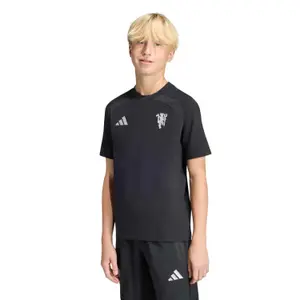

The kids' adidas T-shirt bears the name of a brand founded in 1949 in Herzogenaurach, Bavaria, by Adolf Dassler, known as Adi. His nickname and the start of his family name came together to form the word adidas. The brand's three stripes, registered when the company was founded, now feature on sports T-shirts designed for training, football and everyday wear, in kids' and junior sizes.
Three stripes, so you can move with ease.
AEROREADY: the technology behind adidas T-shirts
adidas sports T-shirts are often made with AEROREADY technology, which replaced the old Climalite. It isn’t a fabric in its own right, but a treatment applied to the fabric: the fibres absorb sweat, draw it away from the skin and dry quickly, helping children stay dry while they exercise.
In practice, an AEROREADY T-shirt stays lightweight even after an intense session, doesn’t stick to your back and dries quickly after washing — a bonus when training takes place twice a week. Many styles also contain some recycled polyester, as the brand has pledged to reduce the use of virgin polyester in its products.
Compare T-shirts from other brands
For a more urban look, the adidas Originals page brings together the trefoil T-shirts, the brand’s line inspired by its archive. For performance, Nike T-shirts use Dri-FIT fabric, while those from Puma use dryCELL. Children who run will appreciate styles from Asics, while clubs can turn to teamwear specialists Erima and Macron.
Slanted stripes or trefoil: two adidas logos
adidas uses several logos depending on how the garment is used. Sports T-shirts most often feature the logo with the three slanted stripes, which evokes a mountain to climb and symbolises performance. The three stripes themselves often run over the shoulders or down the sleeves, making them easy to recognise from a distance.
The trefoil, introduced in the early 1970s, became the exclusive emblem of the Originals style line in the early 2000s. For a child who plays sport, T-shirts with the slanted logo are therefore the best choice: they’re designed for movement, with looser fits and technical fabrics, while trefoil styles favour cotton.
adidas children’s sizes: age and height in centimetres
adidas gives children’s sizes by both age and height in centimetres. Size 128 is for a child aged seven or eight, size 140 for nine or ten, size 152 for eleven or twelve, and size 164 for thirteen or fourteen. Older teenagers then move on to size 176.
Height is the most reliable guide: measure your child barefoot and choose the size that matches or is just above their height. adidas sports T-shirts have a regular fit, neither tight nor too loose; a child between sizes will be more comfortable in the larger size, especially if they wear the T-shirt under a sweatshirt or jacket.
adidas T-shirts: when to find a deal
If you’re replacing T-shirts for a growing child, there are a few key times to look out for. Black Friday kicks off the gift-buying season, followed by the end-of-year holidays. The winter sales and spring French Days are a good time to get ready for warmer weather. During the summer sales and up to the start of the school year, the deals page brings together current offers, while the clearance page features the last remaining items from previous collections.
Frequently asked questions
Do adidas T-shirts come up large or small?
adidas sports T-shirts generally come up true to size, with a regular fit. Some more fitted training styles may feel tight around the shoulders; in that case, sizing up gives you more room to move.
How do I wash an adidas T-shirt without damaging the printed stripes?
Turn it inside out, wash at thirty degrees without fabric softener and avoid tumble-drying, as the heat can crack the print. Never iron directly over the stripes or logo: iron on the reverse at a low temperature.
Are adidas children’s T-shirts unisex?
Most adidas junior sports T-shirts are unisex, with the same fit for girls and boys. Some styles have a more fitted cut for girls; this is noted in the product description.
Is an adidas T-shirt suitable for football?
Yes, adidas training T-shirts are designed for exercise and are ideal for football training sessions. For official matches, however, the club requires players to wear its team shirt in the team colours and with the team number.
Where do adidas’ three stripes come from?
Adi Dassler first used them as support on his early athletics styles, before making them the mark of his company in 1949. Since then, they’ve featured across the brand’s clothing, on the shoulders, sleeves or sides.











