
Girls’ clothing, the French Days selection








The girls’ clothes in the French Days collection cover everything a child needs from nursery to secondary school: T-shirts and sweatshirts for school, dresses and skirts for warmer days, jeans and jogging bottoms for playing, and padded coats, fleeces and waterproof sets for going out in all weathers. Orders are prepared and dispatched within 24 hours.
A complete wardrobe for every season.
What size clothing should I buy for a growing girl?
In France, children’s sizes are given by age, but height is what really matters. As a guide, a size for a four-year-old corresponds to about 104 centimetres, a size for an eight-year-old to 128 centimetres, and a size for a twelve-year-old to 152 centimetres. Scandinavian brands such as Name it and Sofie Schnoor also give children’s height directly in centimetres.
Measure your daughter barefoot, with her back against a wall, and choose the size that matches her height rather than her age. For outerwear that needs to last two winters, going one size up makes sense; for a T-shirt or leggings, stick to the exact size to avoid clothes that gape and get in the way of movement.
T-shirts, sweatshirts, dresses and trousers for girls in the French Days sale
Each clothing category has its own page. T-shirts brings together cotton tops, shirts and everyday polo shirts. Sweatshirts and Jumpers covers hoodies and knitwear for milder weather. Dresses & Skirts ranges from skater dresses to sweatshirt dresses, while Trousers & Jeans includes everything from bootcut jeans to fleece jogging bottoms.
Puffer jacket, fleece and rain set: three layers for winter
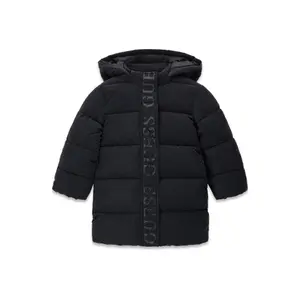
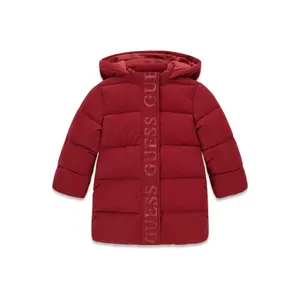
For going out in the cold, the three-layer system is still the most effective: a close-fitting base layer, an insulating layer, then protection from wind and water. A fleece jacket, like those from Peak Mountain, makes a lightweight mid-layer that dries quickly. The long hooded puffer jacket from Guess keeps her warm down to the thighs on the way to school.
On rainy days, the waterproof set comes into its own. Didriksons, founded in 1913 in Grundsund on Sweden’s west coast, where it clothed seafarers, makes its Boardman set from Galon, a coated fabric with welded seams and a fleece lining.
Cotton, technical fabrics and the OEKO-TEX label
Cotton is still a wardrobe staple: it is soft, breathable and stands up to frequent washing. For sport and outdoor wear, technical polyester fabrics dry faster and keep their shape, which is why they are used for leggings and mountain trousers, such as the Glide by Dare 2B.
The OEKO-TEX Standard 100 label guarantees that every part of the garment, from the thread to the buttons, has been tested for harmful substances against set limits. It is a useful guide for clothes worn next to the skin, whether it is a T-shirt, a cotton dress or a sweatshirt.
Key times to update your daughter’s wardrobe
A child’s wardrobe needs updating as they grow. Black Friday is a chance to top up on winter outfits before the end-of-year holidays, then the winter sales clear out puffer jackets and jumpers. The spring French Days help you get ready for warmer weather, the summer sales clear out dresses and T-shirts, and the new school year brings new arrivals. Special offers and clearance are available all year round.
Frequently asked questions
How can I label my daughter’s clothes for school?
Iron-on labels, attached to the care label with an iron, can withstand dozens of washes. A fabric pen is a quick fix, while sew-on labels last the longest on coats.
Should I wash new clothes before wearing them?
Yes, it’s recommended, especially for clothes worn next to the skin. A first wash removes finishing treatments and dye residue that could irritate sensitive skin, and reveals any shrinkage before your child gets used to wearing it.
What clothes should I pack for a school ski trip?
Pack a breathable base layer rather than cotton, a fleece, then a waterproof ski jacket and trousers. Add a change of clothes for the evening, as wet outfits rarely dry overnight.
How should I organise the wardrobe of a child who quickly outgrows clothes?
Keep clothes in the current size separate from those in the next size up, stored in a labelled box. At the start of each season, take out anything that has become too small to give away or sell, and make a note of what’s missing before you buy anything.
Can technical fabrics be washed like cotton?
Not quite: wash them at a low temperature without fabric softener, which clogs the fibres and reduces breathability. Avoid tumble-drying coated or membrane garments, and always follow the care label.











