
Football goals for children, from the garden to the pitch


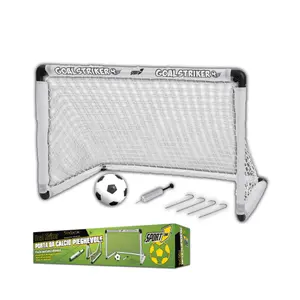


A football goal for children turns the lawn into a pitch: a folding mini goal that can be set up in seconds, a pair of portable goals to secure to the ground for proper family matches, or a rebound net that sends the ball back to practise passing and control on your own. Choose each model according to the player's age, the space available and the type of ground.
Goals sized for them, so they can score from the age of two.
What size football goal is right for each age?
The right goal size should suit the player. At around two or three years old, a lightweight mini goal, only just taller than the child, is enough: they can aim, score and try again without being put off by an oversized goal. Between five and eight years old, a wider model makes it possible to play two-a-side and learn to get shots on target.
At clubs, the guidelines are set by the game: up to U9, children play with goals measuring four metres by one and a half metres; U10 to U13 play eight-a-side on goals measuring around six metres by two metres, before moving up to the adult size of 7.32 m by 2.44 m. In the garden, a target smaller than these sizes is more challenging, and therefore helps players improve.
Football, basketball and other sports games
A goal calls for a suitable ball: the Balls page has options for kicking, dribbling and throwing at every age. Children who prefer aiming high will find their target among the basketball hoops, while the play tunnel and gymnastics accessories complete an outdoor agility course.
Foldable mini goals, portable goals or a rebound net
- The foldable mini goal from Sodex Sport, a French family business that has made sports equipment since 1991 for schools, local authorities and competitions, unfolds and folds away in one movement, so the family can take it from the garden to the park.
- The portable mini goals from the same brand, fitted with hooks to secure the net and a ground anchoring system, can be set up opposite each other for proper matches.
- The Trainer Solo from SKLZ, a Californian training equipment brand based in Carlsbad, is a rebound net stretched over a frame and held in place with pegs: it returns the ball so you can practise passes, control and volleys without a partner.
Anchor a goal to the ground to stop it tipping over
An unsecured goal can tip forwards when a child pulls on the net or hangs from the crossbar: this is the accident most feared with this kind of equipment. In France, the decree of 4 June 1996 also sets stability requirements for football goals made available to the public, which those responsible for them must check regularly.
In the garden, push the supplied ground anchors or pegs fully into soft grass, and check they are secure before each game. On a hard surface, weigh down the base with sandbags. Finally, explain to children that they must never climb on a goal, even a small one.
Football goals at great prices, from Black Friday to back to school
Black Friday comes at just the right time to tuck a foldable goal under the Christmas tree, before the festive season sparks the first dreams of scoring goals. The winter and then summer sales, as well as the spring French Days, are a great time to get back out on the grass as the weather improves, while the start of the school year brings renewed enthusiasm for training between club sessions. All year round, the outdoor and sports clearance offers end-of-line products, while the latest outdoor and sports products showcase the newest models.
Frequently asked questions
Which football goal is best for a two-year-old?
A lightweight, foldable mini goal with no heavy frame is ideal: the child can move it on their own and is less likely to hurt themselves if it falls on them. Pair it with a foam ball, which is easier to kick for a child who is still finding their feet.
Can a foldable goal stay outside all year?
It is best to bring it inside after use. Rain can rust the springs and metal fixings, while the sun gradually weakens the net. Let it dry before folding it into its cover, then store it in a garage or garden shed.
What exercises can you suggest for a child training alone?
With a rebound net, they can practise low passes, controlled first touches and volleys, varying the distance and the foot they use. Add a cone beside the net to give them a target to aim for and keep them motivated.
Can you set up a mini goal on a patio or indoors?
Yes, as long as you replace the pegs with weights, such as sandbags placed on the base. Indoors, choose a foam ball and clear the space around the goal, keeping it away from windows and fragile objects.
Do you need two goals to play as a family?
One goal is enough for penalty shootouts or a goalkeeper game, but two goals facing each other make all the difference: you can attack, defend and learn to play as a team. Portable mini goals are just right for this kind of match.











