
Safety gates for stairs and doors

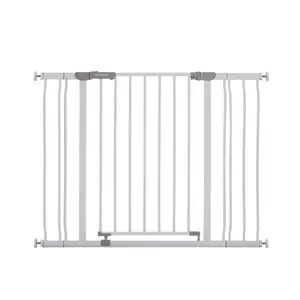
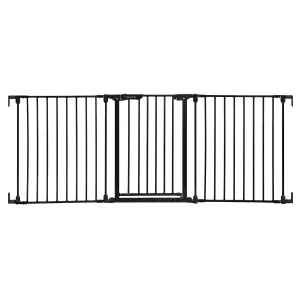
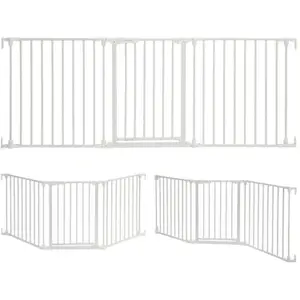
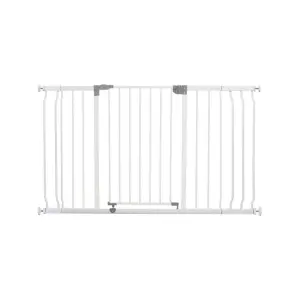


A baby safety gate blocks access to the stairs, kitchen or an entire room as soon as your child starts crawling. Dreambaby with its Ava model featuring an automatic closing mechanism, Chicco, an Italian childcare brand founded in 1958, and Webaby with an ultra-expandable gate, cover narrow and wider openings.
A gate that only grown-ups can open.
Pressure-fit or screw-fixed, depending on the location
The choice depends first on where you want to put it. A pressure-fit gate wedges between two walls or posts using adjustable pressure pads, without drilling: ideal for a kitchen doorway, a hallway or the bottom of the stairs, it can be removed without leaving a mark. A screw-fixed gate is attached to the wall or post with screwed-on hinges; it is the only safe option at the top of the stairs, as it has no bar across the floor to trip over.
At the top of the stairs, also check that the gate opens only towards the landing, never over the drop. At the bottom, position the gate exactly as shown in the instructions.
Bed rails and other protections
At night, bed rails take over, keeping a sleeping child from rolling off the edge of the mattress when they move into a full-size bed. Detectors and other home safety products are grouped in the safety category, so you can equip each room as your child reaches new milestones.
Measure the opening and choose extensions
Measure the width of the opening at the floor and at the top, from wall to wall, allowing for the skirting boards: older walls are rarely perfectly straight. Each gate gives a width range; for wider openings, extensions of a few centimetres can be added on one side, while ultra-extendable models, such as the one from Webaby, can close off an opening into a living room or open-plan kitchen.
For a wooden stair rail or a thick skirting board, an adapter lets you fit the gate without damaging the surface. The Dreambaby Ava, designed for a standard doorway, can also take extensions that increase its width considerably.
Opening and locking for everyday use
A gate is opened and closed dozens of times a day, often with your hands full. The automatic closing feature, as on the Dreambaby Ava, swings the gate shut and locks it behind you, while a hold-open mode leaves it open while you pop back and forth. Being able to open it one-handed, in both directions, means you don’t have to put down the laundry basket.
The lock must be tough enough to keep little hands out: a double-action system, with a button to press and a gate to lift, outwits most children. Check the pressure pads every week, and don’t get into the habit of stepping over the gate, as this wears down the fixings and sets a bad example.
Safety gates: when to buy one during the year
Ideally, install the gate before your child starts moving around on all fours. Black Friday bedroom comes before the end-of-year holidays, when young children often visit homes with stairs; the winter sales, followed by the spring French Days and summer sales, are good times to make a kitchen or the stairs in a holiday home safer before the new school year. Find new models in bedroom new arrivals, and end-of-line products in bedroom clearance.
Frequently asked questions
What standard must a safety gate meet?
The European EN 1930 standard, in its 2011 version, covers gates for children up to twenty-four months old. It sets requirements for height, the gap between bars, strength and locking. Check that it is mentioned on the packaging, especially for a second-hand or imported model.
Until what age should you keep a stair gate?
The standard covers children up to two years old, and the gate becomes dangerous as soon as a child can climb over it, as they could fall from a greater height. Instead, teach your child to go down the stairs sitting down or backwards, always with an adult alongside.
Will pressure pads damage the paint on the walls?
Rubber-ended pressure pads should not leave any marks, but tightening them too much can mark fresh paint or delicate wallpaper. Protective adhesive discs, placed between the pad and the wall, spread the pressure and protect the surface.
Can you fit a gate on stairs with no wall?
Yes, with a fixing kit for a stair rail or post: clamps tightened around the post provide a solid anchor point without drilling. Check that the rail itself is firmly fixed, as it will take the force of your child pushing against it.
Wooden or metal gate: which should you choose?
Metal is slim and strong, making it suitable for wide openings and gates with automatic closing. Wood suits cosy interiors and older staircases, but it is thicker and heavier; in both cases, the gap between the bars must meet the standard.











