
Co-sleeping cots for sleeping safely close to your baby
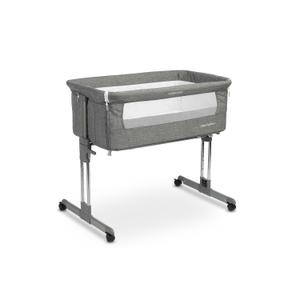
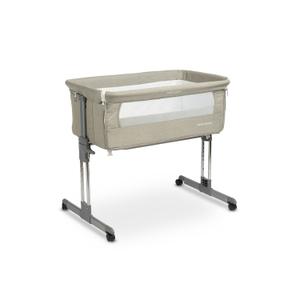




The bedside crib sits next to the parents’ bed, with the side lowered for the adult, keeping your newborn within easy reach while giving them their own sleeping space. Handy for feeds and night-time wake-ups, it adjusts to the height of your mattress, fastens with straps and becomes a classic cot, with the side raised, when you move it around the bedroom.
Baby close by, with a space of their own.
How a bedside cot works
A bedside cot is a cot with a removable side: on the parents’ side, the panel lowers or opens so the baby’s mattress is level with yours, with no barrier between you. Straps passed under the adult mattress or around the bed base secure it to the adult bed, while adjustable feet align the two sleeping surfaces.
This design follows a safe-sleep recommendation: have your baby sleep in the parents’ room, but in their own cot, for the first six months. A bedside cot avoids sharing an adult bed, with its duvet and pillows, while making night-time feeds and comforting your baby easier.
After the bedside cot: cots, mattresses and bedding
A bedside cot is only used for the first few months; baby and children’s cots and beds take over afterwards, including cot beds and convertible models. For a bed you can take with you, travel cots fold up and give your baby somewhere to sleep on holiday. The small bedside cot mattress can be replaced with one from our range of mattresses and pillows, and its smaller fitted sheets are part of our bedding range. Later on, bed guards and accessories help keep a child safe when sleeping in a bed without sides.
Fitting and adjustments: what to check
- Bedside cots must meet the EN 1130 standard, whose 2019 version includes models attached to the parents’ bed: look for this on the instructions.
- There must be no gap between the two mattresses; pull the bedside cot firmly outwards before every night to check that the straps are secure.
- The lowered side must not be higher than the top of the parents’ mattress, so it cannot press against the baby’s throat.
- Raise and lock the side whenever the cot is detached from the adult bed, and use just one mattress—the one supplied by the manufacturer. Never add a mattress topper.
How old should a baby be before they stop using a bedside cot?
Bedside cots are designed for the first few months. Stop using one as soon as your child can sit up, kneel or pull themselves up unaided, which usually happens at around five or six months, or once they reach the maximum weight stated by the manufacturer, often about nine kilos. After that, they could topple over the side.
Some models have an inclined mattress base; however, the recommendation is still for babies to sleep flat on their backs. For children aged two to five who want to sleep near you, a low bed with a guard rail in your room is a better option than a bedside cot.
When to look out for bedside cot deals
Bedside cots are bought towards the end of pregnancy, and the due date often helps decide when to buy. For a winter birth, the bedroom Black Friday deals and the end-of-year sales come at just the right time, followed by the winter sales. The spring French Days and summer sales suit babies due in late summer, while the back-to-school period is a good time for autumn babies. The latest models are listed in new in for the bedroom, and the great deals page brings together current offers.
Frequently asked questions
Will a bedside cot fit a high adult bed?
Most bedside cots can be adjusted to several heights to line up with mattresses of different thicknesses. Measure the height to the top of your mattress before buying: not all fixing systems will fit a very high bed or a divan bed with storage.
Can you attach a bedside cot to either side of the bed?
Yes, most models can be placed on either the right or left; put it on the side of the parent who gets up most often. Just don’t wedge it between the bed and a wall, as this would make it harder to reach your baby.
What sheet should you use in a bedside cot?
A fitted sheet that matches the small mattress exactly, often made specifically for the model, pulled tight with no loose fabric. You can put a thin mattress protector underneath, but never use a blanket or a thick cot bumper.
How do you move a bedside cot from one room to another?
Many models have lockable wheels or fold flat. Before moving it, raise and lock the side, and don’t wheel it around with your child inside, especially over a doorway threshold or a rug.
Can a bedside cot be used as a playpen?
No, its low sides and small surface are not designed for an awake child who can sit up and play. Once your baby can move around and pull themselves up, switch to a playpen or cot, which are taller and more spacious.













