
Crocs for children: lightweight clogs to personalise
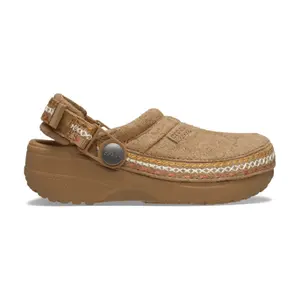
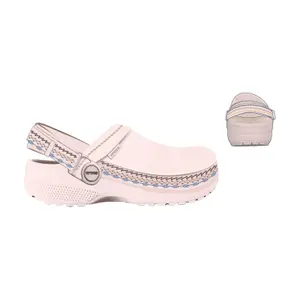


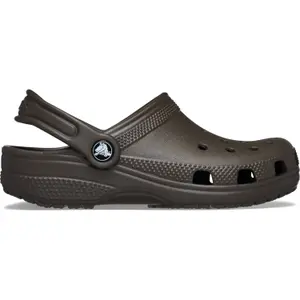
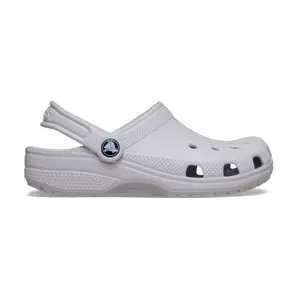
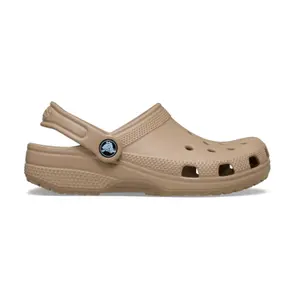


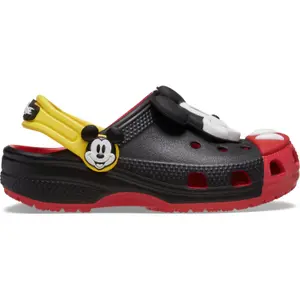


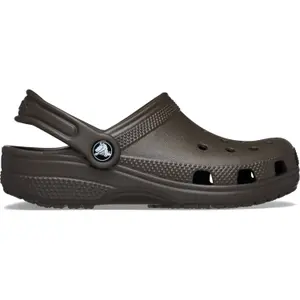


Kids’ Crocs owe their popularity to an exclusive foam that’s lightweight and flexible, rinses clean under the tap and is unbothered by water or sand. With a back strap that swivels to hold the heel in place and holes to fill with Jibbitz, these clogs can be worn at the beach, in the garden or by the pool, and every child can decorate them to their own taste.
Lightweight, washable and ready to decorate.
Crocs, a boat shoe that became a phenomenon
Crocs was founded in 2002 in Boulder, Colorado. Its three founders unveiled their first model, designed for boating, at a boat show in Florida. The secret behind the clog is its material, Croslite, a closed-cell foam resin patented by and unique to the brand. It stays lightweight, flexible and comfortable while resisting odours.
The Classic clog, with its rounded toe and ventilation holes on top, quickly became the brand’s most recognisable style. The children’s version has exactly the same construction, scaled down to fit little feet, so children can wear the same model as their parents.
Compare with other sandals
Depending on how they’ll be used, other styles can complement a pair of Crocs. Havaianas flip-flops slip into a beach bag, canvas Victoria sandals with touch-fastening straps are ideal for days out in town, and sliders from the adidas and Nike pages are great for swimming sessions. For sporty closed sandals, also see Hummel and KangaROOS.
Jibbitz: personalise your Crocs safely
Jibbitz are small charms that clip into the holes in the clog. The idea came from a mother in Boulder, whose children decorated their pairs, and Crocs bought the start-up in 2006. The Classic clog has thirteen holes per foot, offering endless combinations of letters, animals and characters.
To attach one, gently pinch the edge of the hole and push the charm’s base in from the outside until it sits inside the upper. Please note: these are small parts, so keep them out of reach of children under three, who put everything in their mouths. Also check from time to time that no charms have come loose.
C and J sizes: finding the right Crocs size
Crocs uses a US sizing chart: the letter C is for little children’s sizes and J is for junior sizes. Each size corresponds to a double European size: a C10 is equivalent to a twenty-seven–twenty-eight, a C11 to a twenty-eight–twenty-nine, and a J1 to a thirty-two–thirty-three.
Crocs are only available in whole sizes. If your child is between sizes, measure their foot from heel to longest toe and compare it with the length given in the model’s size guide. The clog should leave a little room in front of the toes and around the heel, without the foot slipping about once the back strap is folded down.
Crocs for children: key times to shop
Crocs clogs see children through the whole year, from winter holidays in the sun to afternoons in the garden. Black Friday and the festive season are perfect for giving a pair with a few Jibbitz, and the winter sales are a good time to buy the next size up for summer. The spring French Days kick off the warm-weather season, the summer sales are ideal before heading off on holiday, and at the start of the school year, the deals and shoe clearance offer the last remaining colours.
Frequently asked questions
Do Crocs come up big or small for children?
The Classic clog has a roomy fit, with space around the foot. As it’s only available in whole sizes, measure the foot and check the size guide rather than automatically going up a size.
How do I wash children’s Crocs?
Rinse them with lukewarm water, mild soap and a soft brush, then leave them to air dry. Avoid the washing machine, dishwasher and any source of intense heat: Croslite can warp or shrink at high temperatures.
Can children wear Crocs to school?
Many schools allow them outside PE, as long as the back strap is folded down over the heel. For PE and lively playground games, a closed trainer is more stable and offers better ankle protection.
Are Crocs suitable for a child who’s learning to walk?
They’re lightweight and have a closed toe, which can be reassuring, but their thick sole and inner volume don’t hold the foot as securely as a first walking shoe. Save them for the garden or beach, and always keep the back strap in place.
Do Crocs make feet sweat?
The ventilation holes on top and the closed-cell material help reduce moisture and odours. In hot weather, simply rinse the inside in the evening and leave them to dry in the shade, so the clogs stay fresh for the next day.











