
Scratch cards, the art of revealing colour
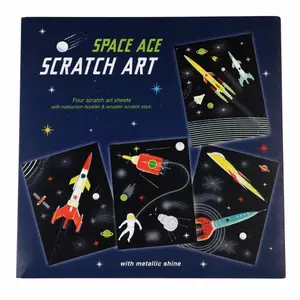
Beneath a thin black coating, the scratch art card hides bright colours or metallic effects that children reveal with the tip of a wooden stylus. The precise, quiet strokes turn each mark into a bright line: a freehand drawing or guided pattern takes shape in just a few minutes, with no paint or pens to spill.
One stroke, and the colour appears.
How a scratch card works
A scratch card has two layers: a coloured base, often rainbow, holographic or gold, with an opaque black layer on top. As the child scratches with the tip of the wooden stylus, they remove the black layer to reveal the colour underneath, stroke by stroke. The pointed end is for fine lines and details, while the flat or bevelled end is for larger areas.
This technique comes from the scratchboard used by illustrators: a board coated with a mixture of kaolin and Indian ink, on which a white-on-black image is engraved. Children’s versions simplify the idea and replace white with bright colours.
Puzzles, brain teasers and other quiet games
For other quiet activities, puzzles call for the same attention to detail, brain teasers test your logic on your own, and card games are a great way to pass the time on a car journey or during an evening with others. Board games and more, meanwhile, bring the whole family together around the table.
What age can children start scratching, and what do they gain from it?
Scratch card packs are generally aimed at children aged four or five and over, when they can hold a fine tool properly and control how hard they press. Before then, children may press too hard, pierce the layer and get discouraged. The action develops fine motor skills, which are also used in writing, as well as precision and patience.
Designs with guides, where a faint outline shows which areas to scratch, help beginners feel confident; blank cards let older children draw whatever they like. The theme matters as much as the technique: space, featured in the Space Age pack by Rex London, animals and mandalas each appeal to a different audience.
Make your own scratch card at home
You can also make a scratch card at home, an ideal activity for a rainy Wednesday. Colour a sheet of card all over with oil pastels, pressing firmly and using different colours, then cover it with a thick layer of black poster paint mixed with a drop of washing-up liquid so it sticks to the oily surface. Once dry, scratch into the card with a toothpick or wooden skewer.
The same idea works for surprise cards, where a message is hidden under a scratch-off patch, to announce a birth or birthday. Protect the message with clear sticky tape, then cover it with a mixture of silver acrylic paint and washing-up liquid.
When to stock up on scratch card packs
Small and lightweight, scratch cards are ideal for Advent calendars, so Black Friday and the festive season are a good time to pick up a few packs. The winter sales and spring French Days are a chance to replenish your supply of quiet activities, the summer sales help you get the bag ready for your holiday, and the new school year brings a host of new toys and games and great deals.
Frequently asked questions
What can you use to scratch if you’ve lost the stylus?
A toothpick, a kebab skewer with a blunt tip or a sharpened wooden stick will all do the job. Avoid sharp metal objects, which can cut into the coloured base and are dangerous for little hands.
Are scratch cards messy?
Scratching produces a fine black dust that you can brush away with your hand or blow into a bin. Put the card on a placemat and avoid rubbing it with your palm, as this spreads the residue over the areas you’ve already scratched.
How do you keep a scratch picture you’re pleased with?
Put it in a clear sleeve or behind glass, as the remaining black layer is fragile and can be marked by even the slightest rub. A spray fixative, applied by an adult in a well-ventilated room, also protects the surface.
Can you use scratch cards in the car or on a plane?
Yes, they’re one of the handiest travel activities: no water, no leaking felt-tip pens and very little equipment. Take a firm tray or a book to use as a surface, and a small bag to collect the scratchings.
What drawing ideas can you suggest to a beginner?
Subjects that make the most of the contrast with the black work best: fireworks, a starry sky, an aquarium or the northern lights. Repeating patterns such as spirals, waves or scales also help children practise the movement without needing to know how to draw.













